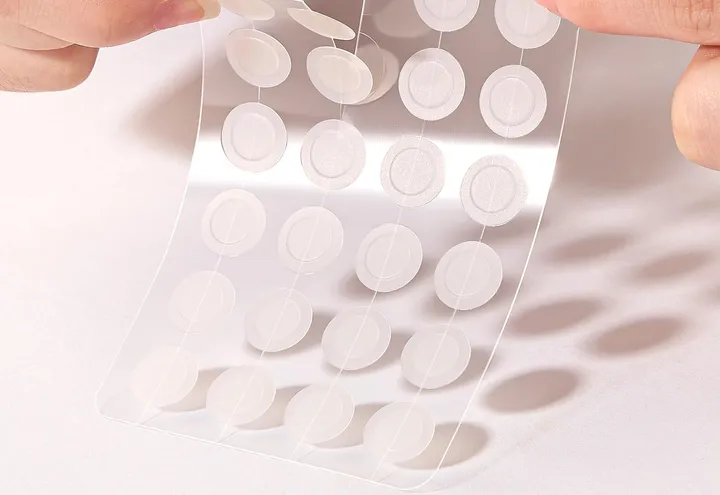
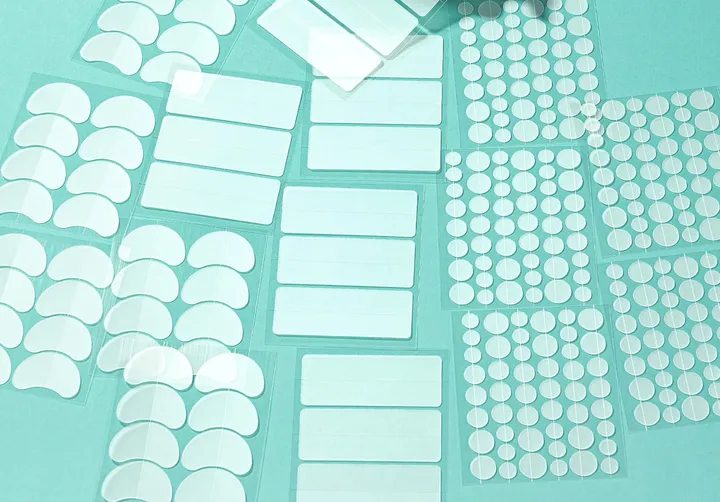
When a dot is too small
A round dot covers one spot. Our dots stop at 14 mm, about the width of a fingertip. Three spots that sit a centimetre apart need three dots, and the edges of those dots overlap and lift each other.
A large patch solves a different problem. One piece of hydrocolloid lies flat over the whole group, so there are no seams to catch on a pillow or a collar. You peel one backing instead of five.
The rule of thumb is simple. Measure the group, not the single pimple. If the group is wider than 14 mm, or if you would need more than two dots side by side, move up to a strip, a square or a contoured shape.
“Pimple patches are small stickers made with a slightly gummy wound-healing gel called hydrocolloid.”
Large patches are the same material as the dots. They cover the area, absorb fluid from spots that have come to a head, and keep fingers and fabric off the skin. The centre turns white as it fills, and that is the sign to change it.
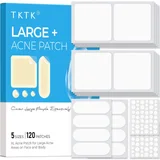
Counts and prices for every box are in the pimple patch size guide. How hydrocolloid works, and how to put a patch on and take it off, is covered in how hydrocolloid pimple patches work.
The large shapes, in millimetres
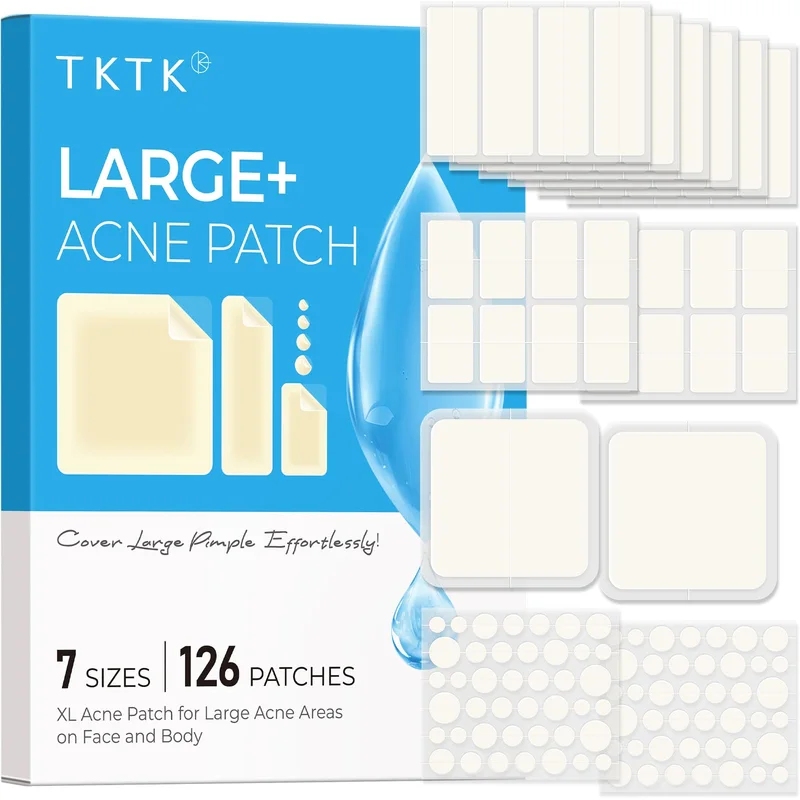
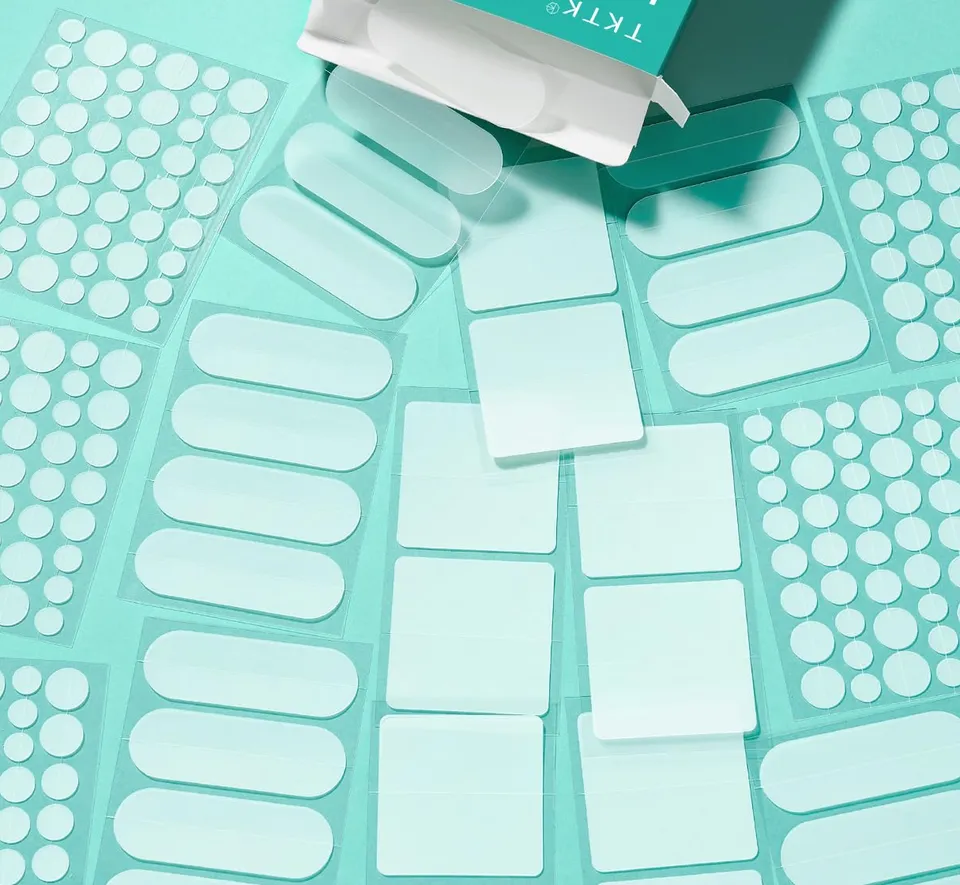
The Large+ line and the nose and chin packs hold strips, ovals, squares and curved shapes, all bigger than a dot. Each one is cut for a place on the face or body. The numbers are the length and width of the patch itself.
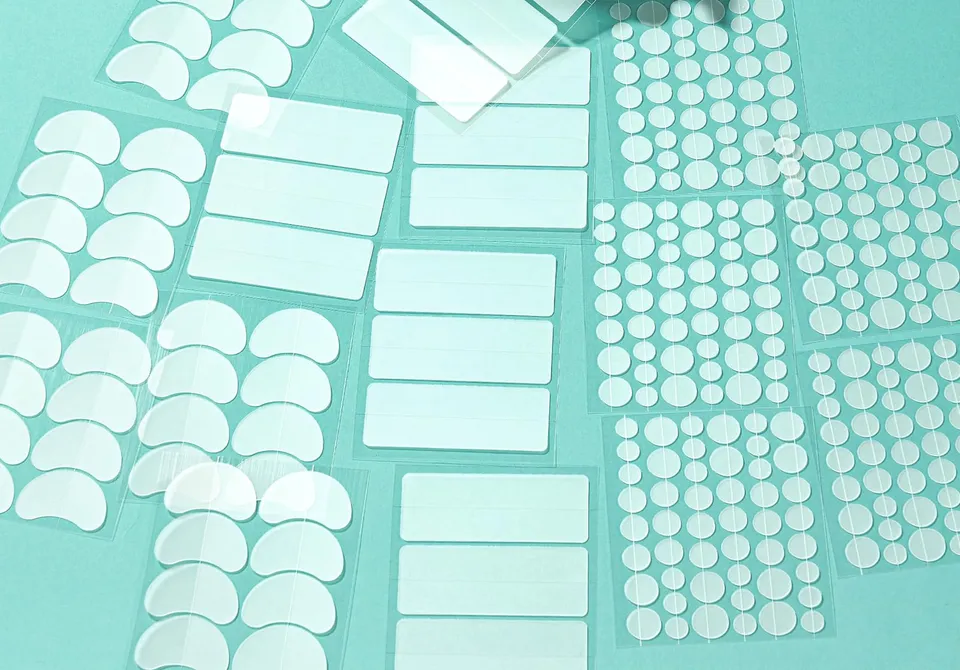
- Strips: 31 x 18 mm, 60 x 20 mm and 68 x 27 mm. A strip suits a row of spots along the hairline, the jaw or the shoulder.
- Small contoured patches: 33 x 23 mm, in the Large+ Strips and the bulk packs. They bridge the gap between a 14 mm dot and a full strip.
- Ovals and squares: 60 x 30 mm, 45 x 45 mm and 60 x 60 mm. These cover a patch of spots on a cheek, the back or the chest.
- Nose shapes: 91 x 48 mm and 104 x 97 mm. Both are contoured to wrap the bridge and the sides of the nose.
- Chin and cheek curves: a 62 x 42 mm crescent, a 38 x 26 mm half-moon and a 46 x 31 mm moon. The curved edge follows the chin, the jawline and the fold beside the nose.
| Area | Shape | Size | Packs with this shape |
|---|---|---|---|
| Forehead, one row of spots | Strip | 60 x 20 mm | All-in-One Combo Pack, Large+ Strips, Large+ Face and Body, XL Stickers, Large Patches, 4 Big Sizes, 45 mm Squares, Large+ Nose Patch, Moon Contoured Patches |
| Forehead or cheek, a wider patch of spots | XL oval | 60 x 30 mm | Bulk Variety Pack, All-in-One Combo Pack, Large+ XL Ovals |
| Cheek or temple, a long line | Long strip | 68 x 27 mm | Large+ 68 x 27 Strips |
| Back, chest or shoulder | Square | 45 x 45 mm | All-in-One Combo Pack, Large+ XL Ovals, Large Patches, 4 Big Sizes, 45 mm Squares |
| Back or chest, the widest area | XL square | 60 x 60 mm | Large+ Face and Body, XL Stickers, Variety Pack, 4 Shapes |
| Nose, bridge and sides | Nose strip | 91 x 48 mm | Variety Pack, 4 Shapes, Large+ Nose Patch |
| Nose, full cover | Nose piece | 104 x 97 mm | All-in-One Combo Pack, Large Patches, 4 Big Sizes |
| Chin and jawline | Crescent | 62 x 42 mm | Chin Patches |
| Beside the nose, cheek curve | Half-moon | 38 x 26 mm | Chin Patches |
| Chin, jawline or nose bridge | Moon | 46 x 31 mm | Moon Contoured Patches |
| Between two spots, a small cluster | Small strip | 31 x 18 mm | All-in-One Combo Pack, Large+ Face and Body, XL Stickers, Large Patches, 4 Big Sizes |
Two numbers help you picture the sizes. A 60 x 20 mm strip is about as long as a house key. A 45 x 45 mm square is under two inches on each side.
Every large pack also holds dots, with one exception. The dots handle the single spots that sit away from the group, so one box covers a whole face or a whole back.
The large packs and what separates them
The large patches come in pre-cut packs. All of them are plain hydrocolloid with no added ingredients listed. They differ in the big shape they lead with and in how many large pieces sit among the dots.
| Item | Sizes in the box | Patches per box | From | Lowest price per patch |
|---|---|---|---|---|
| Large+ Strips | 8 mm, 10 mm, 12 mm, 33 x 23 mm, 60 x 20 mm | 96 / 300 | $6.64 | 4.3¢ |
| Large+ XL Ovals | 8 mm, 10 mm, 12 mm, 60 x 30 mm, 45 x 45 mm | 124 / 248 / 265 | $7.11 | 4.7¢ |
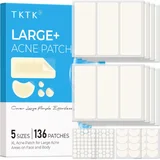
| Large+ Face and Body | 8 mm, 10 mm, 12 mm, 14 mm, 31 x 18 mm, 60 x 20 mm, 60 x 60 mm | 126 / 302 / 472 | $7.99 | 3.8¢ |
| XL Stickers | 8 mm, 10 mm, 12 mm, 14 mm, 31 x 18 mm, 60 x 20 mm, 60 x 60 mm | 142 / 306 | $7.99 | 4.7¢ |
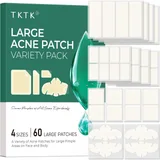
| Large Patches, 4 Big Sizes | 31 x 18 mm, 60 x 20 mm, 45 x 45 mm, 104 x 97 mm | 60 | $7.64 | 12.7¢ |
| 45 mm Squares | 8 mm, 10 mm, 12 mm, 60 x 20 mm, 45 x 45 mm | 120 / 270 | $7.99 | 5.3¢ |
| Large+ 68 x 27 Strips | 8 mm, 10 mm, 12 mm, 34 x 23 mm, 68 x 27 mm | 136 / 295 | $7.99 | 4.8¢ |
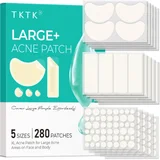
The Large+ Strips lead with the 60 x 20 mm strip and add a 33 x 23 mm contoured patch. Take them for rows of spots on the forehead and along the jaw. The smaller box holds 96 patches for $6.64.
The Large+ XL Ovals swap the narrow strip for a 60 x 30 mm oval and add the 45 mm square. The oval is half as wide again as the strip, so it covers a cheek in one piece. The pack starts at $7.11.
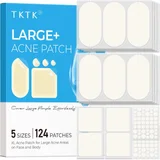
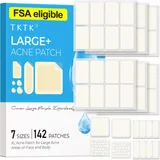
The Large+ Face and Body pack and the XL Stickers hold the same seven sizes, up to the 60 x 60 mm square. The mix is the difference. The 126-patch Face and Body box counts 42 XL pieces, and the 142-patch XL Stickers box counts 58.
The 45 mm Squares pack is built around one shape. The 120-patch box holds 24 extra-large pieces, with 60 x 20 mm strips and dots around them. It is the plain choice for the back and chest.
The Large+ 68 x 27 Strips hold the longest strip in the range. The 136-patch box counts 24 of them, plus a 34 x 23 mm patch and three dot sizes. Choose it when 60 mm falls short of the row you need to cover.
The Large Patches, 4 Big Sizes box has no dots at all. Its 60 pieces are the 45 mm square, the 104 x 97 mm nose piece, the 60 x 20 mm strip and the 31 x 18 mm small strip. It suits people who already own dots and only run out of the big shapes.
Forehead and cheeks: strips, ovals and squares
The forehead is a flat, wide surface, and spots there tend to sit in a line under the hairline or between the brows. A 60 x 20 mm strip follows that line. Two strips end to end cover most of a forehead from temple to temple.
Place the strip so its long side runs with the row of spots. Press from the middle outward so no air stays under it. If the row curves, cut the strip in two and angle the halves.
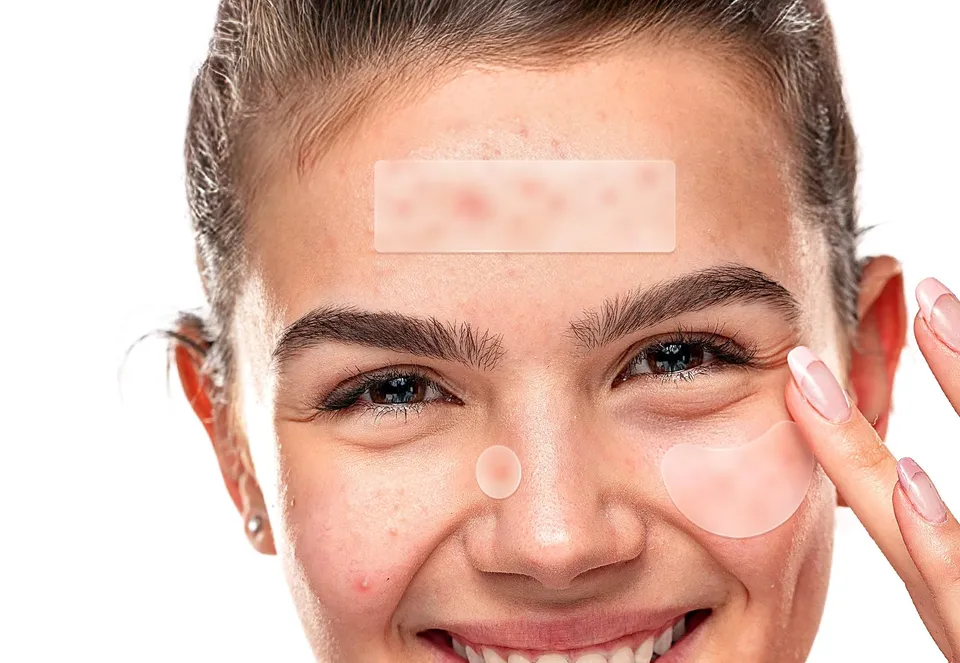
Cheeks are rounder, and a narrow strip wastes its length there. The 60 x 30 mm oval and the 45 mm square give more width for the same piece. The oval has no corners, so nothing lifts when you smile or sleep on that side.
For a patch of spots in the middle of the cheek, the box of Large+ XL Ovals is the direct fit. For a line of spots from cheekbone to jaw, the 68 x 27 mm strip in the 68 x 27 pack reaches further than any other piece.
Large patches show more than dots do. A 60 mm strip on a forehead is visible across a room. Most people wear them at home and overnight, and keep the thin daytime dots from the invisible line for single spots at work or school.
“Keep your hands away from your face. Touching, picking, and popping can worsen acne.”
The nose: a hydrocolloid strip or the blackhead kit
The TKTK range has two different things for the nose, and they do different jobs. One is a hydrocolloid patch cut in a nose shape. The other is a three-step kit that is not hydrocolloid at all.
The hydrocolloid nose patch
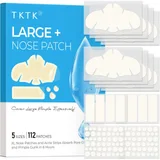
The Large+ Nose Patch measures 91 x 48 mm and is contoured to sit over the bridge and both sides of the nose. The box describes it as a patch that absorbs “excess oil and pus” and suits “overnight use or pre-makeup application”. The pack also holds 60 x 20 mm strips and dots in three sizes.
A larger nose piece, 104 x 97 mm, comes in the 4 Big Sizes box and the All-in-One Combo Pack. The Variety Pack carries the 91 x 48 mm strip next to a 60 mm square and a contoured patch. Pick by what else you want in the box.
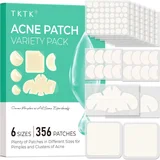
The Blackhead Nose Kit
The Blackhead Nose Kit is a set of non-woven fabric patches with plant extracts. The ingredient line on the box lists houttuynia cordata, witch hazel, golden chamomile, purslane and lignosus rhizoma. It holds no hydrocolloid.
Warm the skin
Cleanse, then hold a warm towel on the nose. The directions on the box start here.
Step 1 patch, 10 to 15 minutes
Apply the first patch, leave it for the time printed on the box, then remove it and use the swab from the kit.
Step 2 patch, 15 to 20 minutes
Apply the second patch. When you take it off, pat in what is left on the skin.
The box sets the pace at “1-2 times per week”. The smaller kit holds 8 sets for $5.99. Buyers rate it 3.4 out of 5 across 37 ratings, the lowest score in our range, so read the reviews before you choose it.
| Item | Large+ Nose Patch | Blackhead Nose Kit |
|---|---|---|
| Material | Hydrocolloid | Non-woven fabric with plant extracts |
| Nose piece | One contoured strip, 91 x 48 mm | Two patches and a swab per use |
| Time on the skin | Overnight or before makeup | 10 to 15 minutes, then 15 to 20 minutes |
| In the box | 112 patches or 265 patches | 8 pieces or 15 pieces |
| From | $7.99 | $5.99 |
| Better choice when | You have spots with a head on or beside the nose and want them covered through the night | You want a weekly routine for the pores of the nose and have 30 minutes for it |
Be clear about what a patch can do for blackheads. A hydrocolloid patch absorbs fluid from a spot that is open or has a head. A blackhead is a plugged pore with no fluid to take up.
““For overall acne treatment, there is little use for pimple patches,” emphasizes Dr. Kassouf. “They cannot prevent acne from coming, nor can they clear clogged pores or other precursors to acne flares.””
“Another common myth is that dirty skin causes acne; however, blackheads and pimples are not caused by dirt.”
Our own kit makes its claims in the words of its box: “3-Step Painless Blackhead Remover”. We repeat those words as the pack prints them and add none of our own. If blackheads are your main concern, a dermatologist can name the products made for them.
Chin and jawline: shapes that bend
The chin is the hardest place to keep a flat patch on. It curves in two directions, it moves when you talk, and it rubs on a pillow. A square laid over a chin lifts at the corners within the hour.
Contoured patches fix that with a curved edge. The Chin Patches pack holds two of them. The XL crescent is 62 x 42 mm for the chin and jawline, and the half-moon is 38 x 26 mm for the cheek, the forehead or the bridge of the nose.
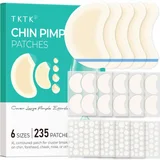
The same pack states a thick centre and “0.45mm ultrathin edges”. The thin edge is what lets the patch lie down on a curve. The box holds 235 patches, with 25 contoured pieces and 210 dots in four sizes.
The Moon Contoured Patches use one mid-size curve, 46 x 31 mm. The box counts 20 moons, 20 strips of 60 x 20 mm and 240 dots. Choose the moon when the crescent is more patch than your chin needs.
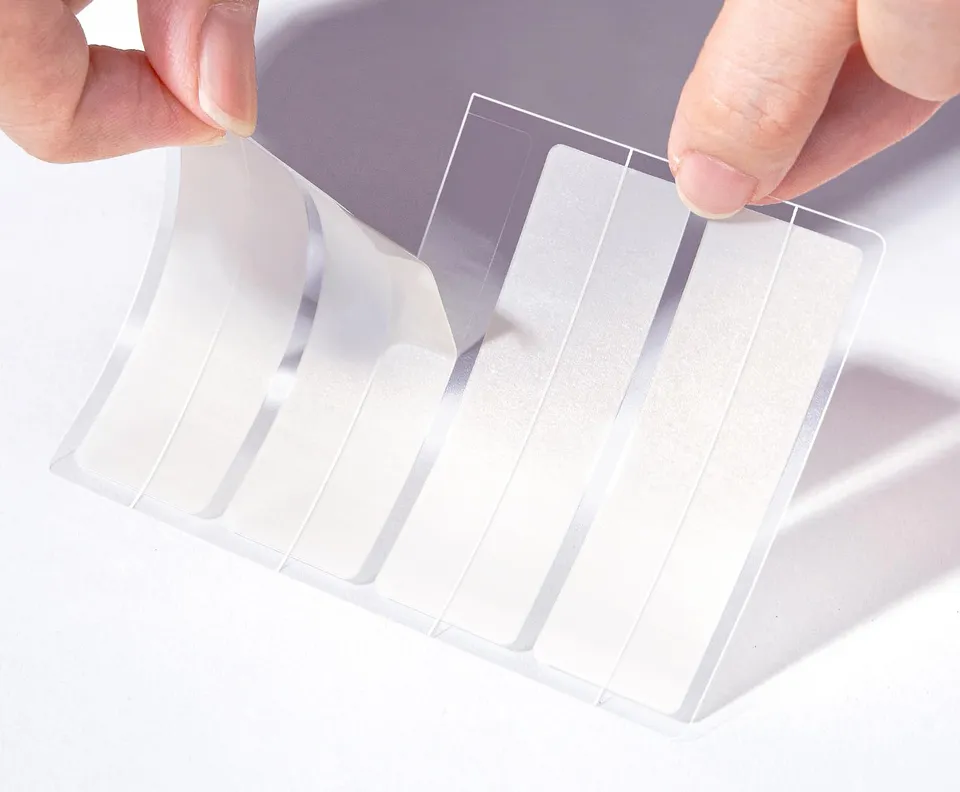
To place a crescent, tilt your head back so the skin under the lip is flat. Set the middle of the curve first, then smooth each tip toward the jaw. Lower your head only after both tips are down.
A chin patch covers the spot that is there today. It does not stop the next one. If the same area keeps breaking out, the answer is a visit, not a bigger box.
“If nothing clears your acne, you should see a dermatologist.”
Back, chest and shoulders
Body skin gives you room, so the largest pieces go here. The 45 x 45 mm square covers a group of four or five spots between the shoulder blades. The 60 x 60 mm square in the Face and Body and XL Stickers packs covers almost twice that area.
The Face and Body description names the back, the chest and the forehead as the places for its XL pieces. The 45 mm Squares box names the same three areas. Neither lists the shoulders, though a square lies flat there as well.
Putting a patch on your own back
You can reach your shoulders, your chest and the top of your back alone. Use a mirror, peel half the backing, set that half down, then pull the rest of the backing away as you smooth the patch.
The middle of the back is another matter. Most people cannot see or reach the skin between the shoulder blades well enough to place a square flat. Ask someone to help, or accept a patch that sits a little off centre.
- Shower first and dry the skin fully. Hydrocolloid does not grip damp skin or skin with lotion on it.
- Put the patch on before you dress, and wait a minute before a shirt goes over it.
- Choose a loose cotton top for the night. A tight strap or a seam across the patch will roll its edge.
- Peel slowly in the morning, along the skin and not straight up.
“While it can be tempting to pick, pop, or squeeze your acne, doing so will make the acne take longer to clear and increase your risk for scarring and dark spots called post-inflammatory hyperpigmentation.”
A large patch on the back also stops you scratching or picking at the spot without noticing. That matters most at night and at a desk. It is the one job a patch does on every kind of spot, with a head or without.
Body breakouts that spread, hurt or leave marks are a medical question. No patch in any size is a plan for those. The advice from dermatologists is to book a visit.
“If you have deep or painful acne, seeing a dermatologist is necessary to help clear your acne.”
The roll: cut your own length
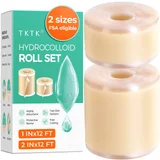
The Hydrocolloid Roll is the same material sold as tape. Each set holds two rolls, one 2 inches wide and one 1 inch wide. That is about 51 mm and 25 mm, so the wide roll sits between our 45 mm and 60 mm squares.
You cut the length yourself. A strip of the wide roll as long as your hand covers the top of a shoulder in one piece. No pre-cut patch in the range does that.
Think of the roll as cut-to-fit hydrocolloid for large areas of breakouts. One set replaces several sheets of squares when the same area flares up often.
| Set | Total length | Price | Price per foot |
|---|---|---|---|
| 2 rolls, 5 ft each | 10 ft | $6.99 | $0.70 |
| 2 rolls, 10 ft each | 20 ft | $9.49 | $0.47 |
| 2 rolls, 12 ft each | 24 ft | $14.99 | $0.62 |
How to cut it
Measure the area
Hold the end of the roll against the skin and mark the length with a fingernail. Add about a centimetre at each end.
Cut with the backing on
Use clean scissors and cut straight across. The box describes a wide backing made for “easy, curl-free removal”.
Round the corners
Snip the four corners into curves. Square corners are the first part to catch and lift.
Peel and press
Peel the backing, lay the piece from one end to the other, and press it flat for a few seconds.
The roll has no dots, no curve and no thin edge. Its cut edge is as thick as its middle, so it shows more on a face than a contoured patch does. Keep it for the body and for the large flat areas of the forehead.
| Item | Hydrocolloid Roll | Pre-cut large patches |
|---|---|---|
| Widest piece | 2 in, about 51 mm | 60 x 60 mm square |
| Length | Any length you cut, up to 12 ft per roll | Fixed, up to 68 mm |
| Tools | Scissors | No tools |
| Edges | Straight, as thick as the middle | Rounded or contoured |
| Dots in the box | No dots | Three or four sizes in most packs |
| From | $6.99 | $6.64 |
| Better choice when | The area is longer than 68 mm, such as a shoulder or the length of the spine | You want to peel and stick with no cutting, or you need dots in the same box |
Buyers give the roll 4.5 out of 5 across 432 ratings. Compare the price per foot before you choose a length. The longest set is not always the lowest per foot.
Trimming, showers and clothes
Which patches you can cut
Several of our large packs state that the patches can be cut. The Face and Body box puts it as “can be trimmed to fit your specific breakout area”. The Large+ Strips, the 45 mm Squares, the XL Stickers and the 68 x 27 Strips make the same point in their own words.
Cut with the backing still on and round the new corners. A 60 x 60 mm square cut in half gives two 60 x 30 mm pieces. A 60 x 20 mm strip cut in three gives three 20 mm squares for spots too big for a 14 mm dot.
| Start with | Cut | You get |
|---|---|---|
| 60 x 60 mm square | In half | Two 60 x 30 mm pieces |
| 60 x 60 mm square | In quarters | Four 30 x 30 mm squares |
| 60 x 20 mm strip | In three | Three 20 x 20 mm squares |
| 45 x 45 mm square | In half | Two strips of about 45 x 22 mm |
Do not cut the contoured chin and moon patches. Their thin edge is the reason they stay down, and a cut edge loses it.
Water and sweat
Only one product in this group makes a water claim on its box. The Hydrocolloid Roll is described as “waterproof” and as a tape that “stays firmly in place during showers or exercise”. Those are the pack’s words.
The pre-cut large packs make no water claim on their boxes, so we make none for them. Plan to put them on after the shower and after the gym. If a patch gets soaked and its edge lifts, replace it with a fresh one on dry skin.
Under clothes
A patch under a shirt meets friction all day. Smooth fabrics slide over it. Ribbed knits, backpack straps and bra bands grab the edge and roll it.
Place the patch so no seam or strap crosses it. On the shoulder, move the strap or wear the patch only at night. On the chest, a square with rounded corners outlasts one with sharp corners.
How long to leave it
The directions on the large packs read alike: clean and dry the skin, apply the patch, and leave it overnight or for the desired amount of time. Several boxes add “6-8 hours”. Change the patch when the centre has turned white, and do not stretch one piece across two nights.
Planning a large area
Plan a large area before you peel anything. Lay the patch on the skin with its backing on and look at where the corners fall. If a corner lands on a fold or a hairline, turn the piece or pick the next shape down.
Two pieces can sit side by side when one is not enough. Leave a gap of a few millimetres between them instead of an overlap. An overlapped edge has nothing flat to hold, and it is the first place a patch lifts.
Skin that moves asks for smaller pieces. The top of the shoulder, the side of the neck and the lower jaw stretch every time you turn your head. Two short strips follow that movement, and one long strip pulls against it.
Count what a large area uses before you choose a box. A forehead covered every night takes one strip a night, which is seven a week. A back that flares up twice a month takes far fewer, and a small box lasts.
Day or night: when to wear a large patch
A large patch is easy to see. A dot can pass for a freckle from across a room, and a 60 mm square cannot. Most people keep the big shapes for the night and for the parts of the body that clothes cover.
Night has a second advantage. You are not talking, eating or pulling a bag strap over your shoulder, so the edges get hours without friction. Put the patch on after your evening wash, once the skin is fully dry.

During the day
Some areas hide a patch during the day too. A strip at the hairline sits under a fringe or a cap. A square on the upper back or the chest sits under a T-shirt, where nobody sees it and cotton slides over it.
On an open cheek or the middle of the forehead, a large patch will show. If that bothers you, cover the area at home and switch to a thin dot on the worst spot when you go out.
A routine for one large area
Evening
Wash, dry the skin and place the patch. Press the edges for a few seconds, corners last.
Morning
Check the centre. If it has turned white, peel the patch slowly along the skin and throw it away.
Daytime
Leave the skin bare under clothes when you can, or use a fresh piece if the area still needs cover.
Next evening
Start again with a new patch. One piece is for one wear, however clean it looks.
Keep a note of how many pieces a week this takes. After two weeks you will know whether a small box is enough or whether a bigger count costs you less per patch.
Who should skip large patches, and when to see a dermatologist
Large patches are a narrow tool. They suit a group of surface spots that have come to a head, on skin that tolerates adhesive. Outside that case they do little, and it is better to know before you buy.
“Acne nodules and cysts develop deep under your skin, unlike other forms of acne, such as whiteheads or blackheads.”
- Deep, painful lumps with no head. A patch has no fluid to absorb there. It can still keep your hands off.
- Blackheads and rough, bumpy skin with no fluid. Hydrocolloid does not open a plugged pore.
- Skin that reacts to adhesive. A 60 mm square puts far more adhesive on the skin than a dot. The warning on our boxes is short: discontinue use if you feel unwell.
- Daytime wear on the face. A large patch is easy to see. The thin dots in the invisible line are made for that.
If that list describes you, a box of dots may serve you better. The pimple patches department holds the round sizes from 8 to 14 mm. The nose and chin department holds the contoured shapes.
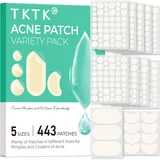
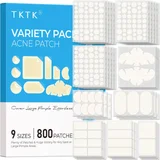
The Bulk Variety Pack is the middle path. It holds dots, a 33 x 23 mm contoured patch and the 60 x 30 mm oval in one box, with up to 609 patches. Buyers rate it 4.6 out of 5 across 4,301 ratings.
When a patch is not enough
A patch is a cover for one breakout. It is not a routine for acne that keeps coming. Dermatology sources set clear points at which to stop buying patches and book a visit.
“If your deep, painful pimple doesn’t go away after following these tips, or if you develop multiple deep, painful pimples, partner with the acne expert, a board-certified dermatologist.”
“If you don’t see results from treatment in six to eight weeks, see a dermatologist.”
Breakouts that spread across the back and chest, hurt, or leave dark marks or dents are reasons to book that visit. None of this is medical advice, and a patch should never delay the appointment.
For everything else, start with the area. Forehead rows take a strip, cheeks take an oval, the back takes a square, the chin takes a crescent, and anything longer takes the roll. The large pimple patches department lists all of them with current prices.