Every TKTK patch size in millimetres
A pimple patch has one job that depends on size: it has to cover the spot and still grip flat skin around it. Too small, and the edge sits on the bump and lifts. Too large, and you spend a big patch on a small spot.
Every TKTK box gives its sizes in millimetres. Round dots carry one number, the diameter. Shaped patches carry two, the length and the width. There are 21 products in the range, and most boxes mix several sizes on separate sheets.
Read a two-number size as a footprint. A 60 x 20 mm strip is as long as a house key and as wide as a thumbnail. A 45 x 45 mm square is about the face of a wristwatch. The shapes differ because faces and backs are not flat, and a spot rarely sits in the middle of an open plain.
Three sizes do most of the work. The 8 mm, 10 mm and 12 mm dots sit in nearly every box, because most spots on a face are smaller than a fingertip. The larger shapes exist for places where spots arrive in groups: the forehead, the chin, the nose, the back.
Small, middle and large
It helps to sort the sizes into three groups. Dots from 8 to 16 mm cover one spot. Middle shapes from 31 x 18 mm to 68 x 27 mm cover a cluster. Squares, nose patches and chin shapes cover an area. The rest of the choice is which group you reach for most often.
“Pimple patches are small stickers made with a slightly gummy wound-healing gel called hydrocolloid.”

How to measure a spot and why the patch goes wider
Measure the raised part of the spot, not the redness around it. A ruler held near a mirror is enough. Read the number in millimetres, because that is the unit on the box.
Then add a margin. The center of a hydrocolloid patch does the absorbing, and the rim does the holding. The rim needs a few millimetres of flat, dry skin on every side, or it will peel when you move or sleep.
Measure the bump
Read the widest point of the raised area in millimetres. Ignore the flat pink skin around it.
Add the rim
Add a few millimetres on each side. A 4 mm bump takes an 8 mm or 10 mm dot.
Check the surface
On a curve such as the side of the nose, go one size up or choose a contoured shape. A flat dot lifts on a sharp curve.
Count the neighbors
Two or three spots within a finger’s width are one job. Cover them with one strip instead of three dots that overlap.
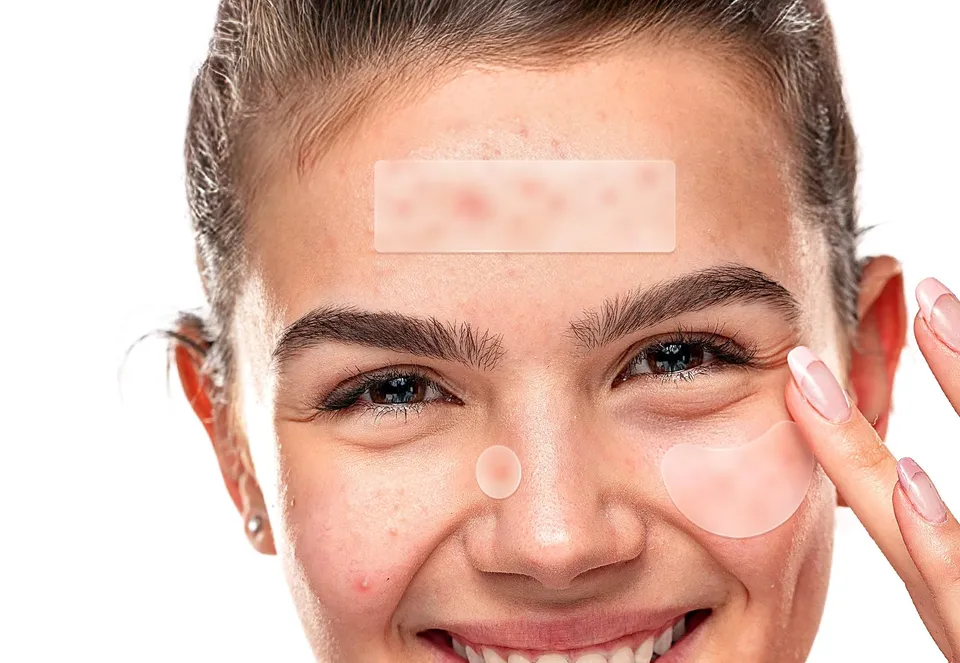
The second reason to cover a spot is your own hands. A patch is a physical barrier between a fingertip and a pimple, and dermatologists are direct about why that matters.
“Keep your hands away from your face. Touching, picking, and popping can worsen acne.”
Curves, hairlines and eyebrows
Adhesive holds on skin and lets go on hair. A dot that overlaps an eyebrow or the hairline will lift on that side. Place it with the rim on bare skin, or trim a larger patch to follow the hair.
Skin that folds needs the same care. The crease beside the nostril, the dip under the lip and the angle of the jaw all move when you talk and eat. Use the smallest patch that still covers the spot there, because a small patch bends with the skin and a big one buckles.

Measuring without a ruler
No ruler in the bathroom? Use what is in your pocket. A US dime is about 18 mm across, and a penny is about 19 mm. A spot that hides under a dime with room to spare fits a 12 mm or 14 mm dot.
The eraser end of a pencil is about 6 to 7 mm wide. A spot that size takes a 10 mm dot, which leaves a rim on each side.
For a row or a cluster, measure end to end, not spot by spot. Hold a strip of paper against the row, mark both ends and lay the paper on a ruler later. Add a centimetre to the length and pick the strip that covers it.
Write the number down once you have it. The next time a spot shows up in the same place, you can skip the measuring and reach for the same size.
Check the fit after a minute. The rim should lie flat all the way round, with no wrinkle and no raised corner. If one side stands up, peel the patch off and use the next size up on dry skin.
How a hydrocolloid patch absorbs fluid, and how to put one on
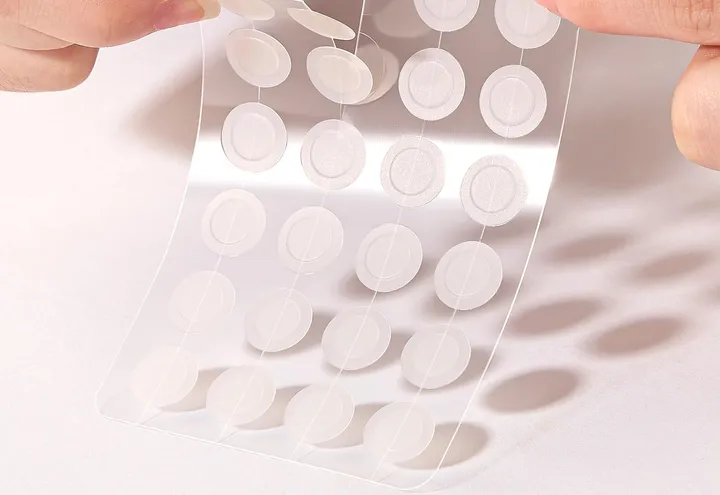
Round dots: 8, 10, 12, 14 and 15 mm
Dots cover single spots. The difference between sizes looks small on paper and large on skin: a 12 mm dot covers more than twice the area of an 8 mm one.
- 8 mm: a fresh, small whitehead, or a spot beside the nostril where a wider dot would fold.
- 10 mm: the default for one average spot on the cheek, chin or forehead.
- 12 mm: a wider spot, or one that needs a little more rim to stay on overnight.
- 14 mm: the largest dot in our mixed boxes, for a spot with a broad base or two tiny ones side by side.
- 15 mm: sold only in the Invisible+ Patches line, one size per box.
“If the pore closes up, you’ll see a tiny bump that looks white or flesh colored. These are whiteheads.”
The 14 mm dot is the one people overlook. It is missing from several mixed boxes, which stop at 12 mm and jump straight to a shaped patch. It comes in the Original Dots, the Clear Cover Dots, the Large+ Face and Body, the XL Stickers and the Chin Patches. Choose one of those if your spots tend to have a wide base.
Our Original Dots and Clear Cover Dots hold all four sizes from 8 to 14 mm and nothing else. They are the boxes to buy when your spots are single and small. The Original Dots start at $6.99 for 140 patches.
Thin-edge dots for daytime
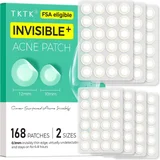
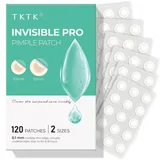
The invisible line narrows the choice on purpose. The Ultra-Thin Invisible and the Invisible Pro come in two sizes each, 10 mm and 12 mm, with an outer edge that the pack gives as 0.01 cm. A thin edge shows less under makeup, so two sizes are enough for a face in daylight.
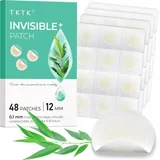
The Invisible+ Patches work differently. Each box holds one diameter, 12 mm or 15 mm, so you choose the size when you choose the box. The pack lists salicylic acid among its ingredients, and it is the only dot we sell at 15 mm.
The 16 mm exception
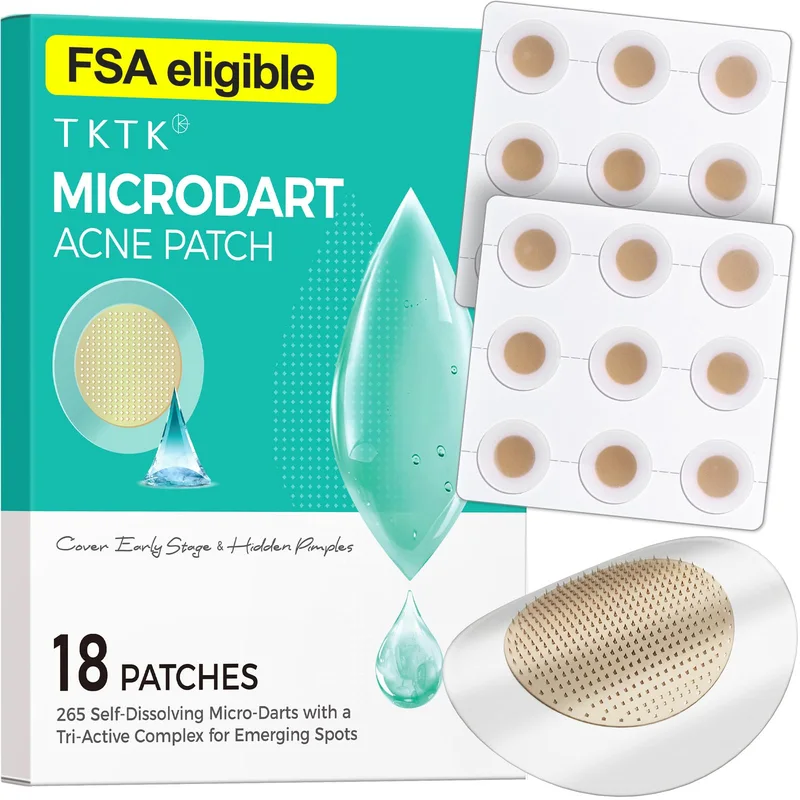
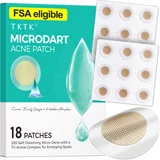
The Microdart Patches measure 16 mm across, wider than any plain dot. The extra width is not for bigger spots. The pack describes 265 self-dissolving microdarts set in a 9 mm zone at the center, and the ring around that zone is adhesive. Buy it by purpose, not by diameter.
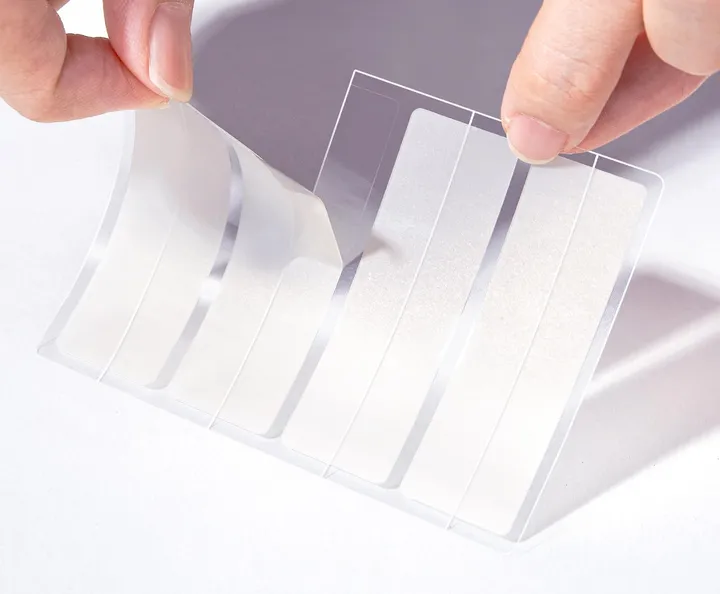
Contoured patches and strips: 31 x 18 mm to 68 x 27 mm
Between a dot and a full sheet sits the middle of the range. These shapes cover a cluster, which is a group of spots too close together for separate dots.
- 31 x 18 mm small strip: two or three spots in a line, such as along an eyebrow or the jaw.
- 33 x 23 mm contoured patch: a rounded shape for the curve of the chin or the bridge of the nose.
- 60 x 20 mm strip: a row of spots across the forehead or along the hairline.
- 60 x 30 mm XL oval: a wide patch for a cheek or the shoulder.
- 68 x 27 mm long strip: the longest pre-cut strip we make.
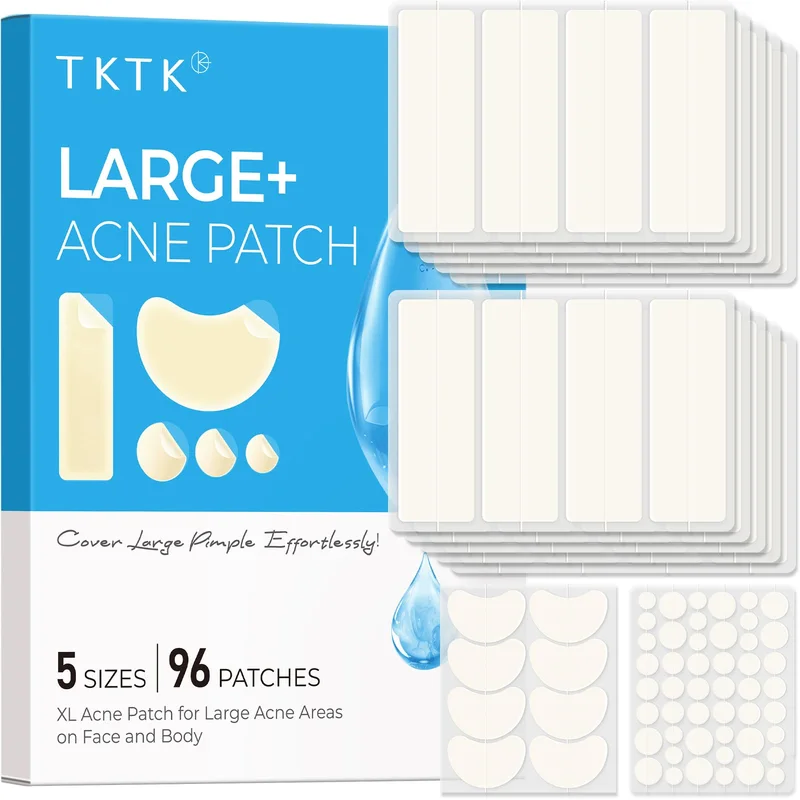
The 60 x 20 mm strip is the most common large shape in the range. It appears in the Large+ Strips, the 45 mm Squares, the Large+ Nose Patch and the Moon Contoured Patches box. If you only ever need one shape beyond dots, this is the one.
The other middle shapes are spread more thinly. The 33 x 23 mm contoured patch comes in the Bulk Variety Pack, the Large+ Strips and the Variety Pack, 4 Shapes. The 31 x 18 mm small strip comes in the Large+ Face and Body, the XL Stickers and the Large Patches, 4 Big Sizes. The 60 x 30 mm XL oval comes in the Bulk Variety Pack and the Large+ XL Ovals. Check for the shape you want before you look at the count on the front of the box.
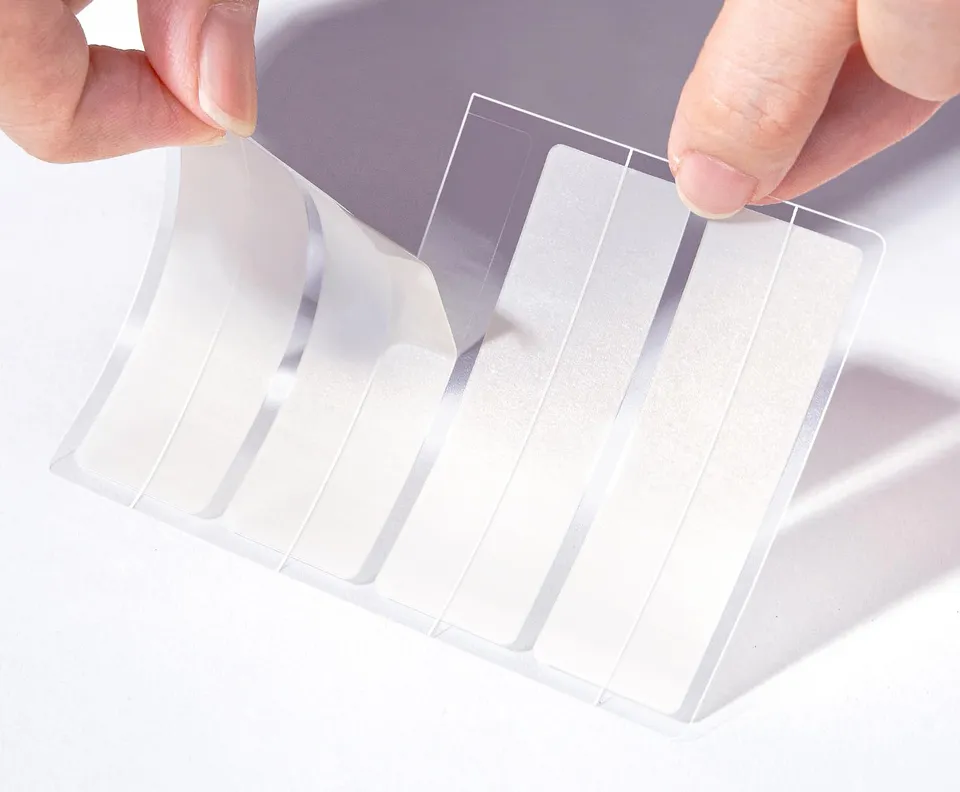
Several of our large packs say on the box that you can cut the patches. A 60 x 20 mm strip cut in half gives two 30 x 20 mm pieces, and a strip cut lengthwise fits beside the nose. Cut before you peel the backing, with clean scissors.
The Large+ 68 x 27 Strips pack pairs its long strip with a 34 x 23 mm patch and the three small dots. Choose it over the 60 x 20 mm packs when the row you want to cover is wider than three fingers.
Squares, nose patches and chin shapes
The largest patches are built for one area each. That makes them easy to choose: you buy them for the place, not for the spot.
Squares: 45 x 45 mm and 60 x 60 mm
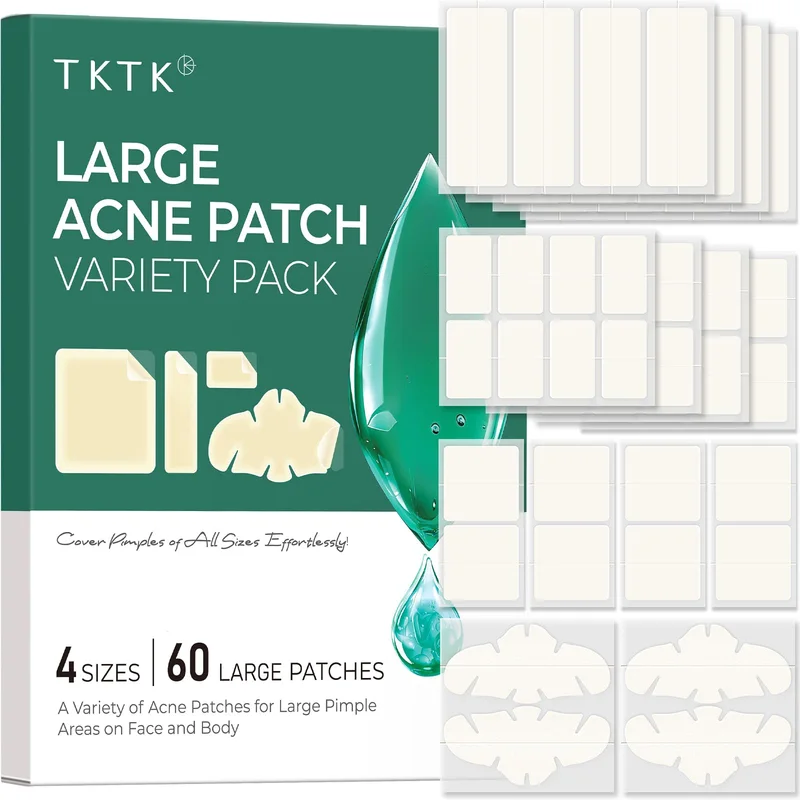
A square covers a patch of skin the size of a matchbox or larger. The 45 x 45 mm square is in the 45 mm Squares, the Large+ XL Ovals and the Large Patches, 4 Big Sizes. The 60 x 60 mm square, the biggest flat patch we make, is in the Large+ Face and Body, the XL Stickers and the Variety Pack, 4 Shapes.
Squares suit flat, broad skin: the upper back, the chest, the middle of the forehead. On a curved area a square wrinkles at the corners. Trim the corners round or choose an oval.
The two squares are further apart than the numbers suggest. A 60 x 60 mm square has nearly twice the surface of a 45 x 45 mm one. Take the smaller square for the forehead and the larger one for the back or chest.
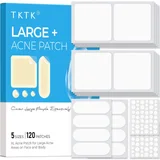
Nose patches: 91 x 48 mm and 104 x 97 mm
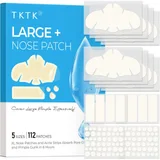
We make two nose shapes, and they are not the same piece. The 91 x 48 mm strip lies across the bridge and down both sides. It comes in the Large+ Nose Patch and the Variety Pack, 4 Shapes. The 104 x 97 mm patch is cut to cover the whole nose, and it comes in the Large Patches, 4 Big Sizes and the All-in-One Combo Pack.
Chin shapes: crescent, half-moon and moon
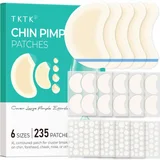
The chin curves in two directions, so a flat rectangle lifts there. The Chin Patches carry a 62 x 42 mm crescent for the chin and jawline and a 38 x 26 mm half-moon for the cheek or the bridge of the nose. The box holds 25 of these contoured patches and 210 round dots from 8 to 14 mm.
The Moon Contoured Patches use a smaller curve, 46 x 31 mm. One box holds 20 moon patches, 20 strips of 60 x 20 mm and 240 dots. Take the crescent for a broad chin area and the moon for the fold beside the nose or a narrow jaw.
Which sizes come in which pack
A box is a mix. Before you buy, check two things: the smallest size, which tells you whether the box handles single spots, and the largest, which tells you whether it handles clusters.
Boxes fall into two kinds. A single-purpose box holds one family of shapes: only dots, only big patches, only two thin-edge sizes. A mixed box holds dots plus one or two large shapes. Single-purpose boxes waste less when you know your skin. Mixed boxes forgive a wrong guess.
| Item | Sizes in the box | Smallest | Largest | Largest pack |
|---|---|---|---|---|
| Original Dots | 4 | 8 mm | 14 mm | 840 patches |
| Clear Cover Dots | 4 | 8 mm | 14 mm | 540 patches |
| Bulk Variety Pack | 5 | 8 mm | 60 x 30 mm | 609 patches |
| Microdart Patches | 1 | 16 mm | 16 mm | 36 patches |
| All-in-One Combo Pack | 9 | 8 mm | 104 x 97 mm | 800 patches |
| Invisible+ Patches | 2 | 12 mm | 15 mm | 96 patches |
| Ultra-Thin Invisible | 2 | 10 mm | 12 mm | 264 patches |
| Invisible Pro | 2 | 10 mm | 12 mm | 180 patches |
| Large+ Strips | 5 | 8 mm | 60 x 20 mm | 300 patches |
| Large+ XL Ovals | 5 | 8 mm | 45 x 45 mm | 265 patches |
| Large+ Face and Body | 7 | 8 mm | 60 x 60 mm | 472 patches |
| XL Stickers | 7 | 8 mm | 60 x 60 mm | 306 patches |
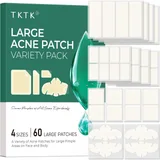
| Large Patches, 4 Big Sizes | 4 | 31 x 18 mm | 104 x 97 mm | 60 patches |
| 45 mm Squares | 5 | 8 mm | 45 x 45 mm | 270 patches |
| Large+ 68 x 27 Strips | 5 | 8 mm | 68 x 27 mm | 295 patches |
| Variety Pack, 4 Shapes | 6 | 8 mm | 91 x 48 mm | 510 patches |
| Large+ Nose Patch | 5 | 8 mm | 91 x 48 mm | 265 patches |
| Chin Patches | 6 | 8 mm | 62 x 42 mm | 235 patches |
| Moon Contoured Patches | 5 | 8 mm | 46 x 31 mm | 280 patches |
Read the table by your own skin. If every spot you get is a single whitehead, a dots-only box wastes nothing. If you get a cluster on the chin once a month and single spots the rest of the time, you want dots plus one large shape.
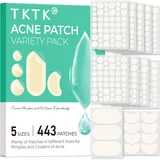
The Bulk Variety Pack is the box we would hand to someone who does not know yet. It holds five sizes: the three small dots, the 33 x 23 mm contoured patch and the 60 x 30 mm XL oval. It also has the lowest price per patch in the range, 1.4¢.
The pimple patch packs cover single spots. The large patch packs add strips, ovals and squares. The nose and chin packs add the shapes cut for one area.
Packs and the price per patch
Our boxes hold from 18 patches to 800. The fair way to compare them is the price of one patch. Divide the price of the box by the number printed on it.
Some of our larger counts are several sealed boxes sold together. The Original Dots are packed 140 to a box, and the bigger options are multiples of that box. You get the same sheets in the same four sizes, and the spare boxes stay sealed until you open them.
| Item | Pack | Price | Price per patch |
|---|---|---|---|
| Original Dots | 140 patches | $6.99 | 5¢ |
| Original Dots | 280 patches | $9.99 | 3.6¢ |
| Original Dots | 420 patches | $13.99 | 3.3¢ |
| Original Dots | 840 patches | $29.97 | 3.6¢ |
| Clear Cover Dots | 180 patches | $7.59 | 4.2¢ |
| Clear Cover Dots | 360 patches | $9.99 | 2.8¢ |
| Clear Cover Dots | 540 patches | $23.97 | 4.4¢ |
| Bulk Variety Pack | 443 patches | $5.99 | 1.4¢ |
| Bulk Variety Pack | 609 patches | $9.99 | 1.6¢ |
| Microdart Patches | 18 patches | $6.99 | 38.8¢ |
| Microdart Patches | 36 patches | $9.49 | 26.4¢ |
| All-in-One Combo Pack | 800 patches | $19.99 | 2.5¢ |
| Invisible+ Patches | 12 mm, 48 patches | $7.49 | 15.6¢ |
| Invisible+ Patches | 12 mm, 96 patches | $12.99 | 13.5¢ |
| Invisible+ Patches | 15 mm, 48 patches | $8.49 | 17.7¢ |
| Invisible+ Patches | 15 mm, 96 patches | $15.99 | 16.7¢ |
| Ultra-Thin Invisible | 168 patches | $7.99 | 4.8¢ |
| Ultra-Thin Invisible | 264 patches | $9.99 | 3.8¢ |
| Invisible Pro | 120 patches | $5.38 | 4.5¢ |
| Invisible Pro | 180 patches | $6.98 | 3.9¢ |
| Large+ Strips | 96 patches | $6.64 | 6.9¢ |
| Large+ Strips | 300 patches | $12.99 | 4.3¢ |
| Large+ XL Ovals | 124 patches | $7.11 | 5.7¢ |
| Large+ XL Ovals | 248 patches | $15.98 | 6.4¢ |
| Large+ XL Ovals | 265 patches | $12.49 | 4.7¢ |
| Large+ Face and Body | 126 patches | $7.99 | 6.3¢ |
| Large+ Face and Body | 302 patches | $14.99 | 5¢ |
| Large+ Face and Body | 472 patches | $17.99 | 3.8¢ |
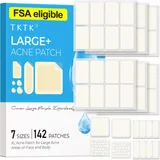
| XL Stickers | 142 patches | $7.99 | 5.6¢ |
| XL Stickers | 306 patches | $14.24 | 4.7¢ |
| Large Patches, 4 Big Sizes | 60 patches | $7.64 | 12.7¢ |
| 45 mm Squares | 120 patches | $7.99 | 6.7¢ |
| 45 mm Squares | 270 patches | $14.24 | 5.3¢ |
| Large+ 68 x 27 Strips | 136 patches | $7.99 | 5.9¢ |
| Large+ 68 x 27 Strips | 295 patches | $14.24 | 4.8¢ |
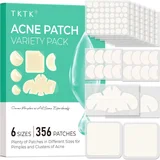
| Variety Pack, 4 Shapes | 356 patches | $8.99 | 2.5¢ |
| Variety Pack, 4 Shapes | 510 patches | $11.99 | 2.4¢ |
| Large+ Nose Patch | 112 patches | $7.99 | 7.1¢ |
| Large+ Nose Patch | 265 patches | $9.49 | 3.6¢ |
| Chin Patches | 235 patches | $9.99 | 4.3¢ |
| Moon Contoured Patches | 280 patches | $9.99 | 3.6¢ |
Two things move the number. The first is the size of the box: a bigger count costs less per patch. The Original Dots cost 3.3¢ a patch at best, and more in the smallest box.
The second is what the patch is. A large patch uses more hydrocolloid than a dot, so a box of big shapes costs more per piece. The Large Patches, 4 Big Sizes hold only large patches, 60 of them for $7.64. A box that mixes many dots with a few large patches shows a low average, and the large patches inside are still the scarce ones.
Patches with something added cost the most per piece. The Microdart Patches run to 26.4¢ each at best, because every patch carries microdarts. The Invisible+ Patches cost 13.5¢ at best. Plain hydrocolloid dots in bulk cost a small fraction of that.
How many patches a month, and which pack to buy
Count patches, not days. One spot usually takes more than one patch, because you replace a patch once it turns white. Two patches for each spot is a fair planning number.
Someone with two or three spots a month uses under ten patches. Someone with a spot most days uses 30 to 60. Someone covering a forehead and a chin every night can pass 90, counting strips.
| Item | Smallest pack | At 1 patch a day | At 3 patches a day | Largest pack |
|---|---|---|---|---|
| Original Dots | 140 patches | 4 months | 46 days | 840 patches |
| Clear Cover Dots | 180 patches | 6 months | 2 months | 540 patches |
| Bulk Variety Pack | 443 patches | 14 months | 4 months | 609 patches |
| Microdart Patches | 18 patches | 18 days | 6 days | 36 patches |
| All-in-One Combo Pack | 800 patches | 26 months | 8 months | 800 patches |
| Invisible+ Patches | 48 patches | 48 days | 16 days | 96 patches |
| Ultra-Thin Invisible | 168 patches | 5 months | 56 days | 264 patches |
| Invisible Pro | 120 patches | 4 months | 40 days | 180 patches |
| Large+ Strips | 96 patches | 3 months | 32 days | 300 patches |
| Large+ XL Ovals | 124 patches | 4 months | 41 days | 265 patches |
| Large+ Face and Body | 126 patches | 4 months | 42 days | 472 patches |
| XL Stickers | 142 patches | 4 months | 47 days | 306 patches |
| Large Patches, 4 Big Sizes | 60 patches | 2 months | 20 days | 60 patches |
| 45 mm Squares | 120 patches | 4 months | 40 days | 270 patches |
| Large+ 68 x 27 Strips | 136 patches | 4 months | 45 days | 295 patches |
| Variety Pack, 4 Shapes | 356 patches | 11 months | 3 months | 510 patches |
| Large+ Nose Patch | 112 patches | 3 months | 37 days | 265 patches |
| Chin Patches | 235 patches | 7 months | 2 months | 235 patches |
| Moon Contoured Patches | 280 patches | 9 months | 3 months | 280 patches |
The table counts every patch as equal, and they are not. A mixed box runs out of its most-used size first. In a dots box that is usually the 10 mm. In a large box it is the big shape, because there are fewer of them.
Three buyers, three boxes
- An occasional spot: the smallest pack of the Original Dots, 140 patches for $6.99. A box that size covers many months of the odd spot.
- A spot most days, mostly on the face: the Bulk Variety Pack at 443 patches for $5.99.
- Clusters on the chin, forehead or back: one large pack for the shape you need, plus a dots box for everything else.
Buy the first box small if you have not worn a hydrocolloid patch before. Skin reacts to adhesive in its own way, and a small box tells you what a large one would. If your skin stays calm, the next box can be the big one.
Two-box sets and the 800-count combo
Some needs span two boxes. Small dots for the face and big patches for the back is the usual pair. We sell 29 two-box sets for that, each made of two packs from the range sold in one purchase.
A set changes nothing about the patches. The sizes are the sizes of the two boxes inside. Read a set as two lines of the size table, and check that the pair covers both your single spots and your clusters.
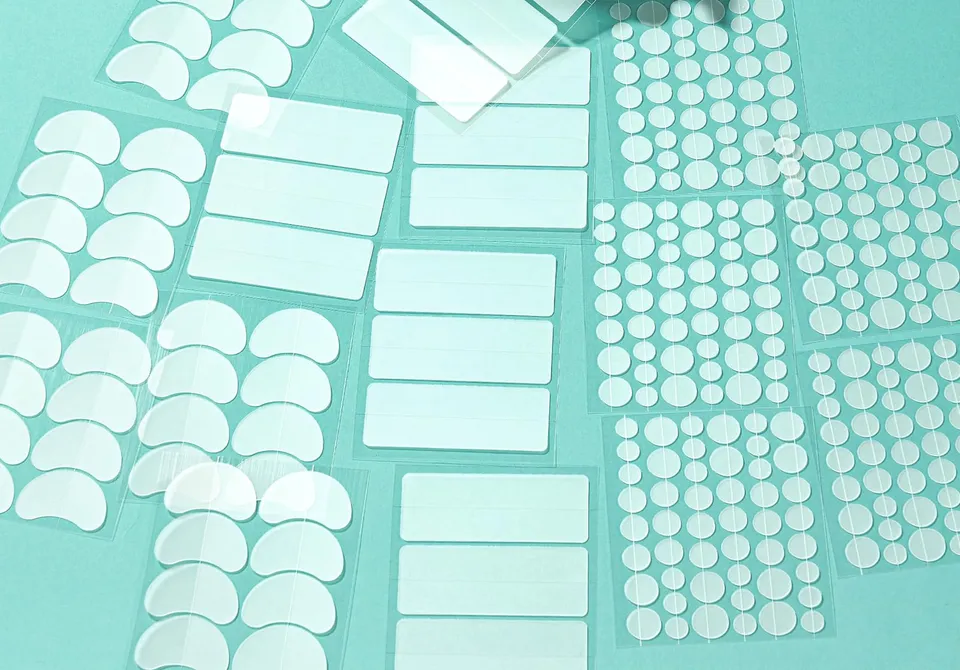
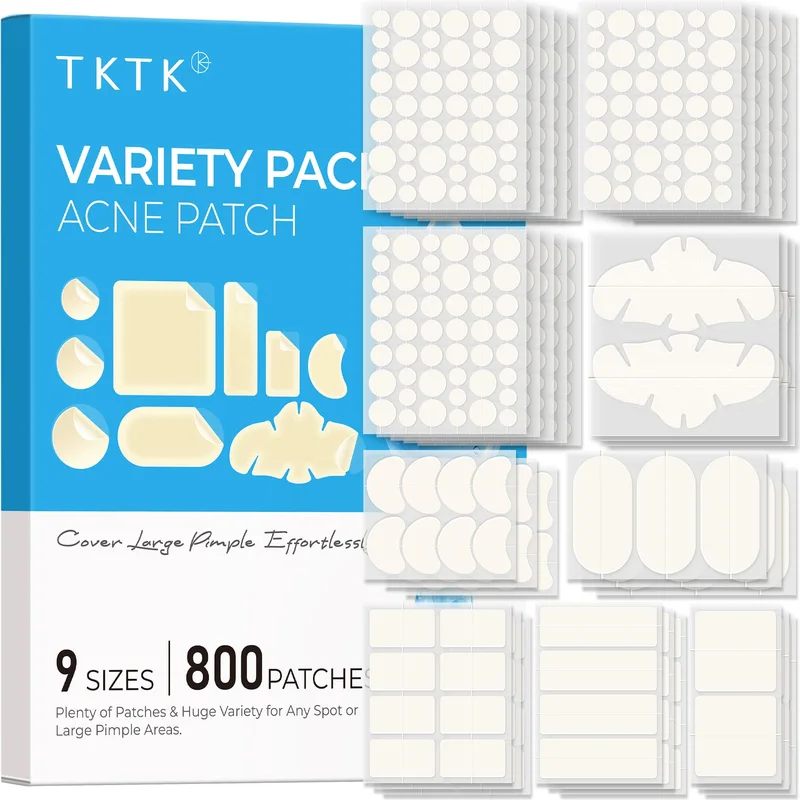
The All-in-One Combo Pack
The All-in-One Combo Pack puts nine sizes in a single box of 800 patches for $19.99.
- Dots: 8, 10 and 12 mm.
- Middle shapes: a 33 x 23 mm contoured patch, a 31 x 18 mm small strip, a 60 x 20 mm strip and a 60 x 30 mm oval.
- Area shapes: a 45 x 45 mm square and a 104 x 97 mm nose patch.
It suits a household where more than one person breaks out, or one person who gets spots on the face and the body. It does not suit someone who only ever needs a 10 mm dot. The box does not print how the count splits across the nine sizes, so do not buy it for one shape alone.
What size cannot fix
A bigger patch is not a stronger patch. Size decides coverage and nothing else. Some spots are the wrong kind for a hydrocolloid patch at any size.
Deep, hard bumps
A bump that sits deep under the skin, with no head and a dull ache, has no fluid near the surface for a patch to absorb. Covering it with a 60 mm square changes nothing under the surface.
“Acne nodules and cysts develop deep under your skin, unlike other forms of acne, such as whiteheads or blackheads.”
A patch can still keep your fingers off such a bump, and that is worth something. It is not a substitute for seeing someone when deep bumps keep coming.
“While it can be tempting to pick, pop, or squeeze your acne, doing so will make the acne take longer to clear and increase your risk for scarring and dark spots called post-inflammatory hyperpigmentation.”
“If your deep, painful pimple doesn’t go away after following these tips, or if you develop multiple deep, painful pimples, partner with the acne expert, a board-certified dermatologist.”
Blackheads and closed bumps
A blackhead is a plugged pore, not a spot full of fluid. Our nose patch box describes absorbing oil around the pores during sleep. It does not promise to lift the plugs out, and neither do we.
““For overall acne treatment, there is little use for pimple patches,” emphasizes Dr. Kassouf. “They cannot prevent acne from coming, nor can they clear clogged pores or other precursors to acne flares.””
Hydrocolloid does its work on spots that have come to a head or already opened. For those, the choice of size is the whole decision, and it is a simple one.
Storing sheets and cutting patches to fit
Patches come on clear sheets, sorted by size. Many of our packs are individually packaged, and the box prints it. Keep a sheet in its wrapper until you need it, and close the box between uses.
- Keep sheets flat. A bent sheet lifts the edges of the patches from the backing.
- Touch only the edge of a patch when you peel it. Skin oil on the adhesive shortens how long it holds.
- Carry a single sealed sheet in a bag, not loose patches.
- Cut large patches before you peel the backing, and round the corners so they do not catch on clothing.
Sort an opened box by size once, and it stays fast to use. Put the sheet you reach for most at the front. When one size runs out before the others, note which one. That is the size to look for in your next box, and it is often a reason to switch from a mixed box to a single-purpose one.
The Clear Cover Dots use a perforated sheet, so one row tears off for a pocket or a pencil case. That is a small thing until you need a patch at school or at work.
When no pre-cut size fits
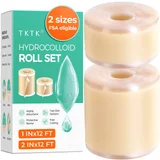
The Hydrocolloid Roll is the answer to an odd shape. One set holds two rolls, 1 inch and 2 inches wide, and you cut any length you need. A roll makes sense for a long line along the jaw or an area on the back that no square matches.
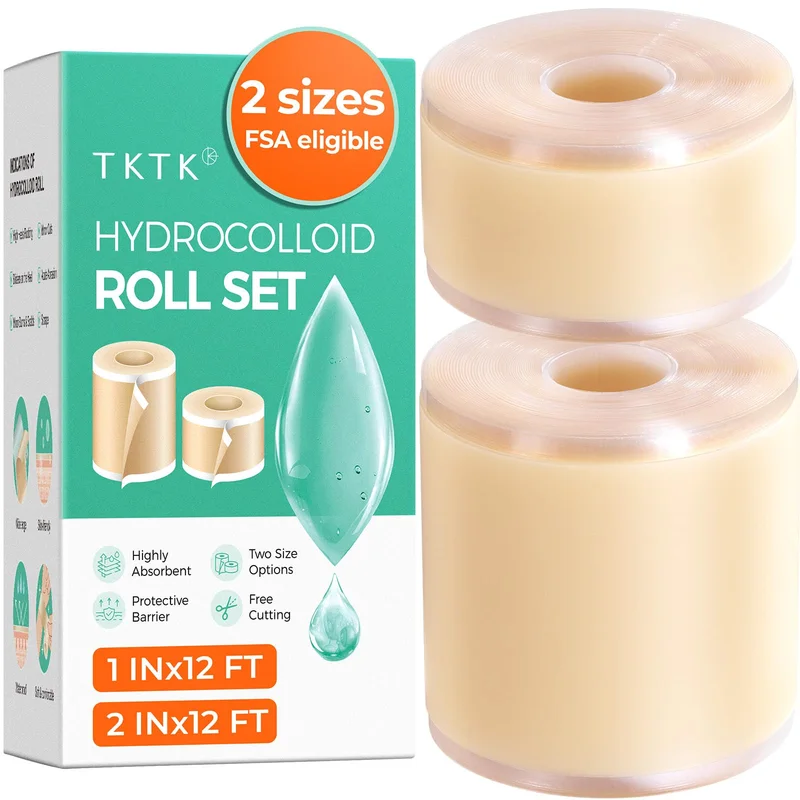
A roll is slower than a dot. You measure, cut and round the corners every time. For single spots on the face, a sheet of pre-cut dots is still the faster choice, and the two work well side by side.